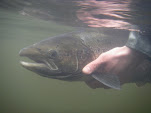
Just as a postscript to the earlier post, this blog's other co-author ventured out in less than promising conditions for a few casts this afternoon and proved the worth of these new-fangled Skagit lines. The river was rising and carrying a tinge of colour but a couple of hours with a 12'9" 8 weight rod lined with 550gr Rio Skagit head and an 8ft T-14 sink tip produced a couple of violent pulls, the second of which resulted in this sea trout being banked. The fly? Let's just say it was a dirty great steelhead fly armed with a size 2 stinger hook and leave it at that! Apologies for the picture of my knee - it was a rushed photograph as I wanted to get the sea trout back in the river where she belongs.
Showing posts with label Skagit. Show all posts
Monday, 31 August 2009
Skagit and all that
Just as a postscript to the earlier post, this blog's other co-author ventured out in less than promising conditions for a few casts this afternoon and proved the worth of these new-fangled Skagit lines. The river was rising and carrying a tinge of colour but a couple of hours with a 12'9" 8 weight rod lined with 550gr Rio Skagit head and an 8ft T-14 sink tip produced a couple of violent pulls, the second of which resulted in this sea trout being banked. The fly? Let's just say it was a dirty great steelhead fly armed with a size 2 stinger hook and leave it at that! Apologies for the picture of my knee - it was a rushed photograph as I wanted to get the sea trout back in the river where she belongs.
Prospects & tactics
The forecast for this coming week is for more unsettled weather, which really suits the Upper Tweed and should hopefully keep the level 'topped up', encouraging fish to keep coming through from lower down.
The regular rods use a range of tactics. Of late, we have been trying out some modern set ups using shorter rods in tandem with skagit lines or shooting heads. Whilst the river up here is not particularly large, these set ups can still be advantageous in tight situations and where greater depth and control is required, particularly later in the year when water temperature is low and the river is pushing through.
At the moment, a rod from 12 - 14' is more than adequate, getting the fly down a little always helps. The successful rods at the weekend were using modest sink tips just to get the fly down a foot or two. One fish was taken on a light skagit set up with a short sink tip and the other utilising a conventional short-head spey line with a slow sink tip.
As for flies, dressed doubles (size 10-8) or smallish light tubes will be all that is required, cascade variants, shrimp patterns or the ubiquitous stoats tail are always a popular choice. If the water really is pushing through (anything above 2' really), don't be afraid to go up to quite a large fly.
The regular rods use a range of tactics. Of late, we have been trying out some modern set ups using shorter rods in tandem with skagit lines or shooting heads. Whilst the river up here is not particularly large, these set ups can still be advantageous in tight situations and where greater depth and control is required, particularly later in the year when water temperature is low and the river is pushing through.
At the moment, a rod from 12 - 14' is more than adequate, getting the fly down a little always helps. The successful rods at the weekend were using modest sink tips just to get the fly down a foot or two. One fish was taken on a light skagit set up with a short sink tip and the other utilising a conventional short-head spey line with a slow sink tip.
As for flies, dressed doubles (size 10-8) or smallish light tubes will be all that is required, cascade variants, shrimp patterns or the ubiquitous stoats tail are always a popular choice. If the water really is pushing through (anything above 2' really), don't be afraid to go up to quite a large fly.
Subscribe to:
Posts (Atom)